GovCMS Alternatives in 2026: When to Stay, When to Leave
A fair look at GovCMS alternatives for Australian agencies: what the platform does well, the real friction points, and a decision framework for 2026.
Jake Tracey29 August 2026GovCMSGovernmentDrupalMigration
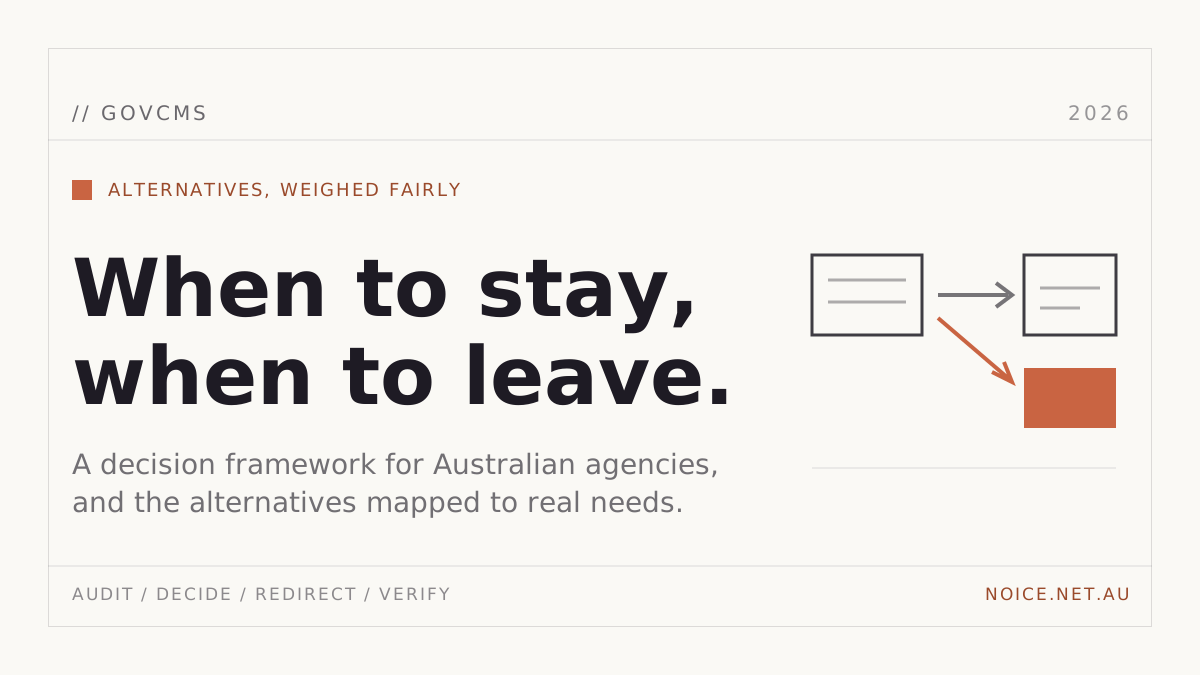
If you type "GovCMS alternative" into a search engine you mostly get vendors telling you to leave. This is not that article, even though we are a vendor and we sell CMS migration and AI for government services. Most agencies on GovCMS should stay on GovCMS. This guide is about working out, honestly, whether you are in the minority that should not.
The timing question is real in 2026. The Department of Finance released a Request for Tender in August 2026 to establish a new combined GovCMS Drupal Services and Digital Experience Platform Services Panel. GovCMS scheduled SaaS Drupal 11 upgrades between March and May 2026. PaaS agencies are responsible for their own application upgrades. Panel transitions and major version upgrades are the natural moments agencies use to re-examine platform decisions, which is probably why you are reading this.
What GovCMS is genuinely good at
GovCMS is a whole-of-government content management and web hosting service, built by government for government, and that framing explains most of its strengths.
Compliance posture. Security compliance with government standards is handled at the platform layer, backed by a 99.95 percent uptime guarantee and 24/7 monitoring. The accessibility baseline is set for you: the platform is built to meet WCAG 2.0 at level AA, and the CivicTheme design system carries a strong accessibility track record. For an agency without a large digital team, inheriting that posture instead of building it is worth a great deal.
Procurement ease. Pricing is published, the delivery models (SaaS and PaaS) are well defined, and design, build and support services come through an established panel of suppliers who know the platform. Procurement teams know how to buy it. That sounds mundane until you have run a full open-market CMS procurement and watched it consume nine months.
Whole-of-government alignment. GovCMS is aligned with the Digital Service Standard, ships a shared design system, and comes with a genuine practitioner community: 398 live websites across 124 organisations as of August 2026, meetups, training, and shared solutions to shared problems. When Rules as Code capability landed on the platform in August 2026, every agency on it got the option at once. That is the shared-service model working as designed.
If those three paragraphs describe what you need, stop reading and stay. Sincerely.
The friction points teams actually report
The friction points are consistent, and they cluster into four themes.
Theming and customisation constraints. The platform's curated approach is a feature until you need something outside it. Custom functionality has to work within the GovCMS distribution and its approved module set, and anything beyond that boundary needs approval, panel work, or both. Teams with strong design ambitions or unusual functional requirements feel the ceiling earliest.
Release cadence is the platform's, not yours. The Drupal 11 upgrade is the clean example: GovCMS scheduled SaaS Drupal 11 upgrades between March and May 2026. PaaS agencies are responsible for their own application upgrades. For SaaS sites that coordinated model is a benefit, because someone else carries the upgrade. But if the window lands mid-campaign, the loss of control has a cost.
Cost at scale. Per-site pricing is transparent and fair for a handful of sites. Agencies running large multi-site portfolios, or sites with heavy customisation layered on top of the base fee through panel engagements, sometimes find the total cost of the GovCMS arrangement compares less favourably with a consolidated platform over a five-year horizon. This is a spreadsheet question, not an ideology question, and the answer differs by agency.
Non-Drupal teams. GovCMS assumes Drupal skills somewhere in the delivery chain. If your engineering team is JavaScript-first, or your roadmap is headless delivery into channels a Drupal theme does not reach, you will be working against the grain. Headless is possible on the platform but it is not the pattern GovCMS is optimised for.
None of these are indictments. They are the standard trade-offs of any shared platform, and the platform is honest about them. The question is whether they bind you.
A decision framework
Stay if:
- Your sites are primarily informational and fit the standard pattern well
- The shared security and accessibility posture is doing work your team would otherwise have to do
- Your customisation needs fit within the distribution, or panel suppliers can meet them affordably
- Your team has, or can procure, Drupal capability
- Platform-scheduled upgrades are an acceptable trade for not running upgrades yourself
Reconsider if:
- You are consolidating a large portfolio and the per-site economics no longer work
- Your roadmap needs capabilities the distribution cannot offer: deep content modelling, complex multi-site governance, first-class headless delivery, or heavy integration
- Your engineering team is not a Drupal team and never will be
- You repeatedly find yourself building around the platform rather than on it
- Platform release windows have materially collided with your delivery calendar more than once
If you tick one box in the second list, that is friction, not a business case. Two or three, and it is worth costing the alternatives properly.
The alternatives, mapped to needs
There is no single successor to GovCMS. The right target depends on why you are leaving.
Self-managed Drupal. The lowest-disruption exit. You keep your content models, your CivicTheme investment and your team's Drupal skills, and you shed the shared-platform constraints. In exchange you own hosting, patching, upgrades and security response, or you pay a managed hosting partner to own them. Honest fit: agencies whose frustration is with the platform's boundaries, not with Drupal itself.
Enterprise DXP, such as Magnolia. For agencies that have outgrown the capability envelope rather than just the governance envelope: sophisticated content modelling, multi-site and multi-language at scale, personalisation, and headless delivery as a first-class pattern. We are a Magnolia Platinum Partner, so weigh our view accordingly, and read our detailed GovCMS versus Magnolia comparison which includes the cases where GovCMS wins. Magnolia can be deployed inside agency-controlled, ISM-aligned Australian hosting.
Managed WordPress for microsites. For campaign sites, event sites and short-lived properties, a locked-down managed WordPress build can be delivered quickly and cheaply. Be honest about its ceiling: governance, accessibility and security become your responsibility to specify and verify, and a fleet of ungoverned microsites is how agencies got into web-estate trouble in the first place. Use it as a deliberate tactical tier, not an accidental one.
AI-governed page platforms. An emerging category worth watching: platforms where agents draft and maintain pages under human review gates, with validation built into the authoring path. Disclosure: we build one, Noice Work, so we are not neutral here. Our measured view is that this category suits content-heavy teams that want to compress the brief-to-published cycle, and that no agency should adopt it without the same assurance scrutiny it would apply to any AI system. Our writing on RAG knowledge bases and AI assurance for government covers what that scrutiny looks like.
If you do leave: how to migrate safely
Most of the risk in leaving GovCMS is not in the destination platform. It is in the move.
Audit before you build. A full content inventory tells you what actually needs to migrate. Large government estates tend to carry superseded, duplicated or orphaned content, and migrating it wholesale just moves the problem. The audit also surfaces the URL inventory you will need next.
Redirects are non-negotiable. Every retired URL needs a 301 to its successor, shipped at cutover, not after. Search equity built over years evaporates quickly behind a wall of 404s, and government sites are linked from everywhere: legislation, media, other agencies' sites, printed material.
Accessibility parity is a release gate. Your GovCMS site meets an accessibility baseline today. The replacement must meet at least that baseline before it takes traffic, verified by testing rather than by the new vendor's brochure. Budget for a WCAG audit of the new build as part of the migration, not as a fast-follow.
Prefer a parallel run to a big bang. Keep GovCMS live while the new platform takes a growing share of traffic. It costs a little more for a period and removes the class of risk that makes migrations newsworthy.
We have written a detailed CMS migration guide covering the mechanics, and our CMS migration service page describes how we run migrations, including the AI-assisted content migration tooling that takes on the routine rebuild work.
The honest summary
GovCMS is a good platform run by people who understand government websites, and the majority of agencies on it are exactly where they should be. The minority who should leave usually know it already: they can name the capability gap, the economics have been tested in a spreadsheet, and the friction is structural rather than seasonal. If that is you, map the alternative to the need, and treat the migration itself, redirects, accessibility parity, content audit, as the part that deserves the most scrutiny. If it is not you, the platform's biggest strength is that you get to spend your attention on content instead of infrastructure. Use it.