AI Knowledge Management for Australian Government Agencies
Why knowledge management breaks inside government agencies, what an AI retrieval layer genuinely fixes, and what records and privacy law still require.
Jake Tracey3 August 2026AIGovernment
Most agencies describe the same problem in slightly different words. The information exists. Someone wrote it down. Nobody can find it, and the officer who understood the context left eighteen months ago.
That is a knowledge management problem before it is an AI problem. What has changed is that a retrieval layer over your own content is now cheap enough to be a serious option, and that switching one on triggers a specific set of Australian obligations that most vendor material does not mention. This page covers both halves: why knowledge management breaks structurally inside government, what an AI layer genuinely fixes, what it does not, and which instruments govern it here.
If you want the architecture rather than the operating picture, the companion piece is Agentic RAG for Australian Government.
Why it breaks, and only one cause is technical
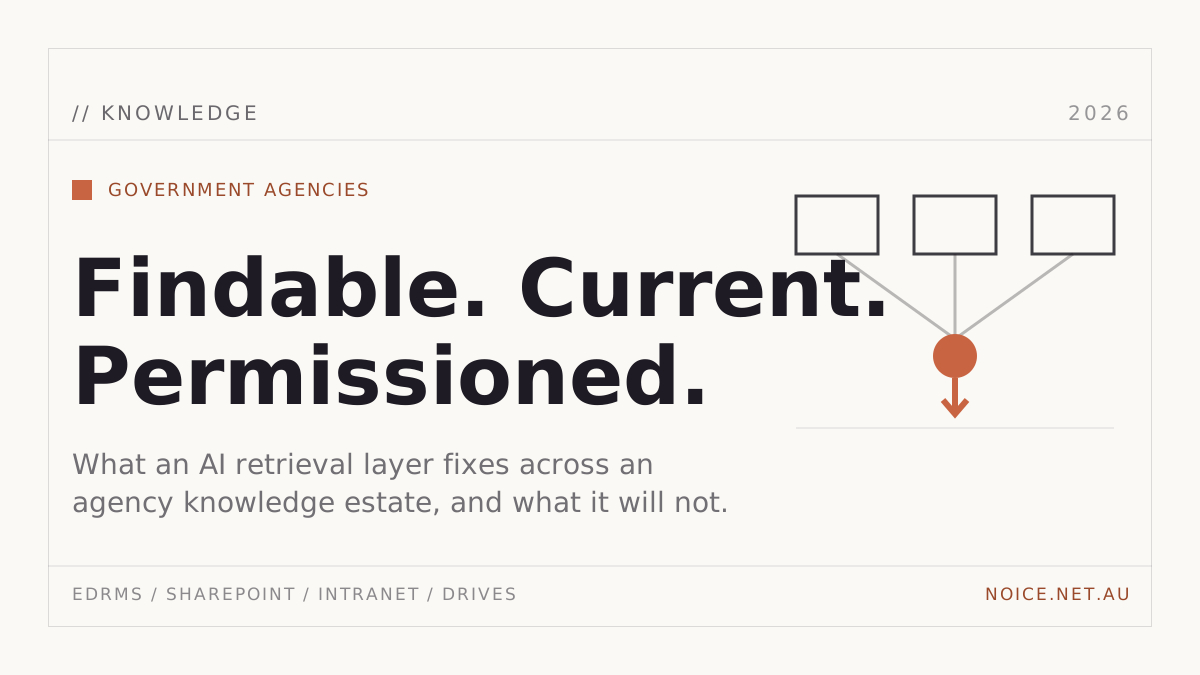
Repositories multiply faster than the taxonomy. A mid-sized agency typically runs an EDRMS, a SharePoint estate, an intranet, a policy library, a service desk knowledge base, network drives inherited from a machinery-of-government change, and several hundred mailboxes. Each has its own permissions model and its own idea of what a "document" is. Enterprise search indexes some of them, badly, and will happily rank a superseded draft above the approved current version.
The knowledge that matters was never written down. Eligibility edge cases, why a clause reads the way it does, which of two conflicting procedures actually applies. This lives in people, and contractor-heavy delivery plus normal APS and VPS mobility moves it out of the building on a rolling basis.
Retention obligations pull against curation. Commonwealth agencies must keep records in line with records authorities issued by the National Archives, and cannot simply delete superseded material because it clutters search. The National Archives is explicit that AI generated content created or received by agencies constitutes Commonwealth records under the Archives Act 1983 and must be managed as such. The Act is technology and format neutral, so a report drafted with AI assistance carries the same retention requirements as the equivalent report drafted without it. Good compliance therefore produces large repositories full of correct-at-the-time material. Search treats all of it as current.
Access control and publication are different problems. A document can be correct, current and completely unsuitable for the officer asking. Any system that answers questions across the corpus has to respect the same need-to-know boundaries the source systems enforce, at query time, per user.
What a retrieval layer fixes, and what it does not
| The failure | What a well-built AI layer does | What it will not do |
|---|---|---|
| Staff cannot find the right document | Answers in natural language, cited back to the source document and version | Invent the answer if the document does not exist |
| Answers are scattered across five systems | Retrieves across connected repositories in one query, within the user's permissions | Reconcile two policies that genuinely contradict each other |
| Superseded content outranks current content | Filters and weights by version and effective date, if that metadata exists | Create the metadata. If nothing marks a document superseded, nothing can filter it |
| Institutional knowledge is undocumented | Makes the gap visible, because unanswerable questions become a measurable queue | Recover knowledge that was never captured |
| New starters take months to become useful | Cuts time-to-answer on routine procedural questions | Replace supervision, judgement or delegation |
| Content quality is uneven | Surfaces which documents are actually consulted, so remediation can be prioritised | Improve the writing. Retrieval over poor content produces confident poor answers |
The honest summary: retrieval fixes findability and speed. It does not fix authorship, governance or currency, and it amplifies whatever is already true about your corpus. A knowledge assistant used as a substitute for a content clean-up is a faster route to the wrong answer. The Office of the Victorian Information Commissioner makes the same point in privacy terms, noting that historical data often carries bias reflective of the period in which it was collected, and that organisations should not assume inferred information is accurate.
The obligations that arrive with the system
| Instrument | Who it applies to | What it requires |
|---|---|---|
| Policy for the responsible use of AI in government, v2.0, effective 15 December 2025 | All non-corporate Commonwealth entities, with some exceptions | Public AI transparency statement, designated accountable official(s), a strategic position on AI adoption, an accountable use case owner, an internal use case register shared with the DTA every six months, and mandatory staff training |
| AI use case impact assessment | Same | Assess new use cases against the in-scope criteria during design. In-scope cases need an impact assessment commenced at design stage and finalised, with risk treatments applied, before deployment. Existing unassessed use cases must be brought into line by 30 April 2027 |
| AI technical standard and its Agentic AI addendum | Strongly recommended, not mandatory | Best practice for the end-to-end design, development, deployment and use of AI systems. The addendum, dated June 2026, adds guidance for systems given autonomy and is to be applied in conjunction with the base standard |
| National framework for the assurance of AI in government, agreed 21 June 2024 | Commonwealth, state and territory governments | Five assurance cornerstones: governance, data governance, a risk-based approach, standards and procurement. It points to current standards including AS ISO/IEC 42001:2023 and AS ISO/IEC 23894:2023 |
| National Archives advice on AI records, January 2025 | Australian Government agencies | AI outputs are Commonwealth records. AI systems are not recordkeeping systems and generally lack the functionality, so outputs that must be kept have to be captured into an approved records system with adequate metadata. Prompts and inputs may also need retaining where outputs are relied on for decisions |
| PROV guidance on AI and recordkeeping | Victorian public offices | Under the Public Records Act 1973 the head of the public office is accountable for full and accurate records, including records of AI technologies, their use and impact. PROV recommends documenting more than the final decision, including the environment and intermediate logic |
| OAIC guidance on commercially available AI products, 21 October 2024 | Entities covered by the Privacy Act 1988 | Privacy obligations attach to both inputs and outputs. Conduct a privacy impact assessment, do due diligence rather than set and forget, and be transparent that an AI tool is in use. APP 10 accuracy obligations apply with force given probabilistic outputs |
| Deploying AI systems securely, ASD ACSC and partners | Organisations deploying AI systems built by another entity | Validation and sanitisation of all input data to reduce prompt injection risk, strict access controls, secured APIs, and logging that covers inputs, outputs, intermediate states and errors |
| Guidance on AI procurement in government, BuyICT | Commonwealth buyers | Assess data and infrastructure readiness before market approach, consider whether data and outputs must be processed, hosted or stored onshore in Australia, use the DTA model AI and cyber risk clauses, and contract explicitly for knowledge transfer and against vendor lock-in |
Victorian agencies carry a parallel set. The Information Privacy Principles under the Privacy and Data Protection Act 2014 apply to personal information fed into or inferred by an AI system, IPP 9 constrains transfers of personal information outside Victoria, and organisations subject to Parts 4 and 5 must meet the Victorian Protective Data Security Standards. The supplier-side view of the Victorian assurance obligations is worth reading before you respond to a VPS approach to market.
Design decisions that separate a deployment from a demo
Permission-trim at query time, not index time. The index should carry the source access control list, and every retrieval should be filtered against the requesting user's entitlements at the moment of the query. Snapshotting permissions at ingestion means a staff movement or a reclassification silently opens content that should have closed.
Cite or say nothing. Every answer returns the source document, its version and its date. This is not a user experience nicety. It is what makes the output reviewable, and it is the mechanism by which an officer can meet the expectation, set out in the policy's preparedness and operations principles, that they be able to explain, justify and take ownership of advice and decisions when using AI.
Treat ingestion as a records event. Log what was indexed, from which repository, at what time, and under what classification. When the corpus changes, log the delta. The National Archives advice on business systems that incorporate AI is direct on this point: where the system lacks records management functionality, outputs and their supporting metadata have to be exported and captured somewhere that does.
Decide what happens to query logs before go-live. Queries frequently contain personal information, sometimes sensitive information, entered by a staff member describing a real case. Those logs are records, they are subject to privacy obligations, and their retention needs a documented position rather than a default.
Keep inference onshore unless you have a considered reason not to. The BuyICT guidance asks buyers to specify, when approaching the market, whether agency data including the inputs and outputs generated by the solution should be processed, hosted or stored onshore in Australia. We run our AI workloads on AWS Bedrock in ap-southeast-2 (Sydney) for that reason. The data sovereignty question deserves its own answer, not a footnote in a service schedule.
Constrain autonomy deliberately. A system that only retrieves and answers is easier to assure than one that iterates, calls tools and takes actions. The DTA's Agentic AI addendum exists because that step change matters. Where you do want iteration, the UK Government Digital Service's note on agentic RAG is a clear read on the failure modes, particularly unintended iterative loops and the way repeated retrieval can compound bias in source data.
Questions worth putting to any vendor
- How are source permissions enforced, and at what point in the pipeline?
- What exactly is logged per query, where does it live, and for how long?
- Where does inference run, and where is the vector index stored?
- How does the system distinguish current from superseded content, and what metadata does that depend on?
- What does the system return when the corpus does not contain an answer?
- Can we export the full record of what was indexed, when, and by whom it was approved?
- What is the exit path? Which artefacts do we keep if the contract ends?
If a supplier cannot answer the first three without escalating, they are not ready for a Commonwealth or VPS deployment.
Where we sit
Noice builds content and knowledge platforms for public sector and regulated organisations. We are a Magnolia Platinum Partner and a Progress reseller through BlueChip Infotech, and we are building the Knowledge Sharing Platform for the Victorian Collaborative Centre for Mental Health and Wellbeing, which goes live in late September 2026. We have written separately on retrieval architecture for agencies and securing AI assistants in government.
If you are scoping a knowledge platform and want the assurance and records questions answered alongside the technical ones, that is the work we do: AI for government. The retrieval layer that usually sits on top of a governed corpus is covered on our RAG development services page.