The Watermark Era: What Anthropic's EU AI Act Move Means for Brand Trust
Claude now marks its output worldwide under EU AI Act Article 50. Why a Brussels rule reaches Australian brands, and how to keep trust.
Ray Tran13 August 2026AIGovernanceBrand
Last week Anthropic became the first major model provider to say it will watermark generated text worldwide. Claude models launched on or after 2 August 2026 embed an imperceptible, machine-readable mark in their output, and supported files carry signed provenance metadata under the C2PA standard. The trigger is Article 50 of the EU AI Act, whose transparency obligations became applicable the same week. The reach is not European. Anthropic confirmed the marking applies in every region where Claude is offered, across its consumer app, its API, Claude Code, and the Claude models inside AWS, Google Cloud and Microsoft Foundry.
It is worth sitting with what that means. A meaningful share of the world's AI-assisted text now discloses itself, invisibly, to any system that knows how to look.
What actually changed
The mechanics matter because they set the boundaries of the change. The text watermark is embedded at the model level: an imperceptible pattern woven into the generated words, invisible to a reader, detectable by machines, and durable enough to survive copy and paste. Anthropic says heavy editing can degrade it. Files are handled differently, through signed provenance metadata that records Claude's involvement and reveals tampering, though conversion, re-saving or a screenshot can strip it.
Anthropic is careful about what a detection means: a watermark is a signal rather than proof. It indicates that text passed through Claude at some point. It says nothing about how much a person shaped the output, what it is based on, or who approved it.
The regulatory floor beneath this is Article 50. Providers of generative systems must ensure synthetic content is marked in a machine-readable way. People must be told when they are talking to a machine. Deepfakes must be disclosed. Fines run to 15 million euros or 3 percent of global turnover. Other providers are subject to the same obligations, so the direction across the industry is set even where implementations differ.
Why a Brussels rule reaches Australian brands
The EU AI Act applies to providers and deployers outside the Union when their system's output is used inside it, so Australian enterprises with European customers are in scope directly. The larger effect is quieter. Platform providers do not build regional forks for transparency plumbing. They ship one implementation globally, as Anthropic just did. The EU's defaults become everyone's defaults through the tooling itself, the same path GDPR took into Australian privacy practice years ahead of local reform.
Australia is moving the same way on its own schedule. The Voluntary AI Safety Standard and the proposed mandatory guardrails for high-risk AI point at the same principles Article 50 encodes: transparency about machine involvement, accountability for outputs, and records that survive scrutiny. An Australian brand that builds for the EU bar today is early, and early here is an advantage rather than a cost.
Disclosure just stopped being optional
Until this month, whether to say that AI helped produce a piece of content was a decision a brand made. That decision is being taken out of brands' hands, one provider at a time. A procurement panel can scan a tender response. A journalist can scan a media release. A platform can scan everything it ingests, at scale, forever.
The asymmetry is the point. Detection is cheap and universal. Concealment is expensive and degrading. Editing a mark out of text is effort spent signalling the one thing a brand least wants to signal, against an ecosystem of marks and detectors that only grows. The brands that get hurt in the watermark era are not the ones using AI. They are the ones whose AI content could not survive being identified as such.
Which reframes the question. The mark tells the world a machine was involved. It cannot tell the world whether anyone checked the work. That second question is where trust now lives, and it is answered by process rather than by messaging.
The three questions behind every piece of content
When AI involvement is detectable by default, a brand needs to be able to answer three things about anything it publishes.
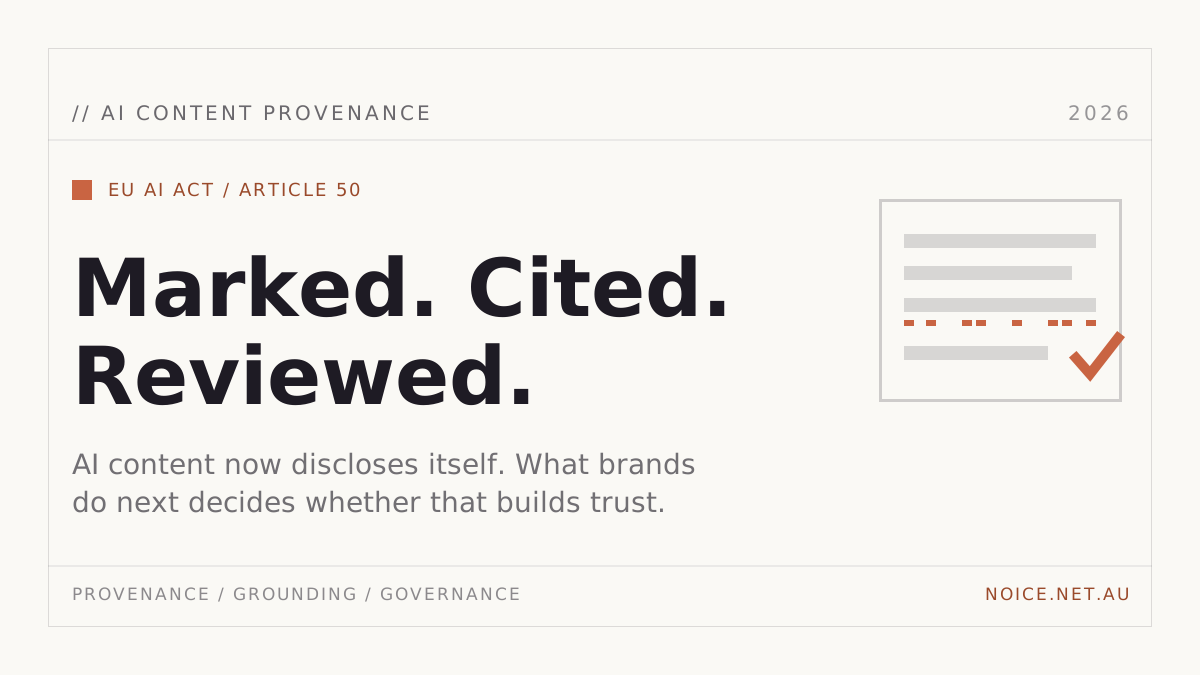
Provenance. What produced this, and what happened to it on the way to publication? Watermarks and C2PA metadata answer the machine half. The human half is a record of drafting, editing and approval that your organisation can produce when asked.
Grounding. What is it based on? Generated text that cites its sources, with the citations resolving to documents you actually hold, is a different asset from fluent text with no lineage. Grounded systems make every claim traceable. Ungrounded ones make every claim a small liability.
Governance. Who approved it, and could you roll it back? Review gates in front of everything audience-facing, a named accountable owner, and releases that can be reversed are what separates a publishing operation from a content pipe.
None of this is a compliance burden invented by Brussels. It is what careful publishers have always done, now with regulatory weight behind it and machine-readable evidence attached. The obligations that arrive with Article 50 mostly formalise the difference between brands that govern their content and brands that emit it.
What to do now
Five moves, in the order we would make them.
- Inventory where AI touches your content. Marketing, support, proposals, product copy, internal knowledge. You cannot set a disclosure posture for flows you have not mapped, and most organisations find more AI in the pipeline than they expected.
- Decide your disclosure posture before it is decided for you. Specific beats general: what role AI plays, what the content is grounded in, who approved it. A one-line provenance note with a named owner does more than a policy page.
- Put review gates in front of anything audience-facing, and keep the records. The approval trail is the artefact that turns "a machine was involved" from an accusation into a footnote.
- Ground customer-facing AI in your own sources. If an assistant answers on your behalf, every answer should carry citations a reader can follow. Disclosure with evidence reads as confidence. Disclosure without it reads as apology.
- Treat provenance standards as an early asset. C2PA-signed media and watermark-aware workflows are cheap to adopt early and awkward to retrofit under deadline. The first brands whose content verifies cleanly will enjoy a trust premium while it is still rare.
This is not theoretical for us
The publishing described here is how we work. Review gates in front of everything audience-facing, citations on every generated answer, releases that can be rolled back, and brand enforcement in the design system itself: it is the discipline behind our own platform, noice.work, and behind the government knowledge systems we build, where these obligations arrived earlier and with sharper teeth. For the public sector version of this conversation, start with our guide to agentic RAG for Australian government or the AI for government practice page.
If you want to work out what the watermark era means for your content operation, a one-hour conversation will map your exposure and the order to fix it in. Talk to us.
Provenance note: this article was drafted with AI assistance, grounded in the cited reporting and regulation, and reviewed, edited and approved by Ray Tran. That is the process the article recommends, applied to itself.